What is CBTi and How Does it Treat Insomnia?

By Andrew Heathcock | SynapReset Insomnia Therapy, Brisbane
The Gold Standard Treatment for Insomnia You’ve Probably Never Heard Of
If you’ve been struggling with insomnia, chances are you’ve tried everything — sleep hygiene tips, melatonin supplements, sleep tracking apps, herbal teas, and maybe even prescription sleeping pills. And yet here you are, still lying awake at night.
There’s a reason none of those things have provided lasting relief: they treat the symptoms of insomnia, not the cause.
Cognitive Behavioural Therapy for Insomnia — known as CBTi — is different. It’s the only treatment proven to address the root cause of chronic insomnia, and it’s recommended by the world’s leading sleep and medical organisations as the first-line treatment — ahead of sleeping pills.
Yet most people have never heard of it.
In this article, we explain exactly what CBTi is, how it works, and why it’s the most effective long-term solution for insomnia available today.
What Does CBTi Stand For?
CBTi stands for Cognitive Behavioural Therapy for Insomnia.
It is a structured, evidence-based program that identifies and changes the thoughts, behaviours, and habits that are keeping you awake at night. It is derived from Cognitive Behavioural Therapy (CBT) — one of the most widely researched and validated forms of psychological therapy in the world — and has been specifically adapted and refined for the treatment of insomnia over more than 50 years of clinical research.
Who Recommends CBTi?
CBTi is not a fringe or alternative treatment. It is endorsed as the first-line treatment for chronic insomnia by:
In clinical studies, CBTi has consistently outperformed sleeping pills — both in short-term effectiveness and, crucially, in long-term outcomes. The improvements from CBTi are maintained years after treatment ends. The improvements from sleeping pills typically disappear when the medication is stopped.
How Does CBTi Work?
CBTi works by targeting the two main factors that perpetuate chronic insomnia:
1. Unhelpful Thoughts (The “Cognitive” Part)
People with insomnia often develop a set of negative beliefs and anxieties around sleep that make the problem worse:
These thoughts trigger anxiety, which activates the body’s stress response — making sleep physiologically harder to achieve. CBTi identifies these thought patterns and replaces them with more accurate, balanced perspectives that reduce sleep-related anxiety.
2. Unhelpful Behaviours (The “Behavioural” Part)
Over time, people with insomnia develop behaviours that seem logical but actually make insomnia worse:
CBTi introduces specific behavioural techniques that rebuild your body’s natural sleep drive and re-establish a strong association between bed and sleep.
The Core Techniques Used in CBTi
A structured CBTi program typically includes several evidence-based components:
Sleep Restriction Therapy
Counterintuitively, one of the most effective CBTi techniques involves temporarily reducing time in bed to match your actual sleep time. This consolidates fragmented sleep, rebuilds your sleep drive, and breaks the cycle of lying awake in bed for hours. Most clients find this the most challenging — and most transformative — part of the program.
Stimulus Control Therapy
This technique re-establishes the mental association between your bed and sleep (rather than wakefulness and frustration). It involves specific guidelines about when and how to use your bedroom, helping your brain learn to associate bed with sleepiness again.
Sleep Hygiene Education
While sleep hygiene alone rarely cures insomnia, it plays a supporting role in CBTi. This covers the environmental and lifestyle factors — light exposure, caffeine, exercise timing, bedroom temperature — that influence sleep quality.
Cognitive Restructuring
Working through the specific thoughts and beliefs driving your sleep anxiety, and replacing them with evidence-based, balanced perspectives that reduce arousal at bedtime.
Relaxation Techniques
Practical tools to reduce the physical and mental arousal that makes it hard to fall and stay asleep — including breathing techniques, progressive muscle relaxation, and mindfulness-based strategies.
Sleep Scheduling
Establishing a consistent, personalised sleep schedule that works with your body’s natural circadian rhythm rather than against it.
How Effective is CBTi?
The research is compelling:
CBTi vs Sleeping Pills — What’s the Difference?
This is one of the most common questions we receive at SynapReset Insomnia Therapy in Brisbane. Here’s a straightforward comparison:
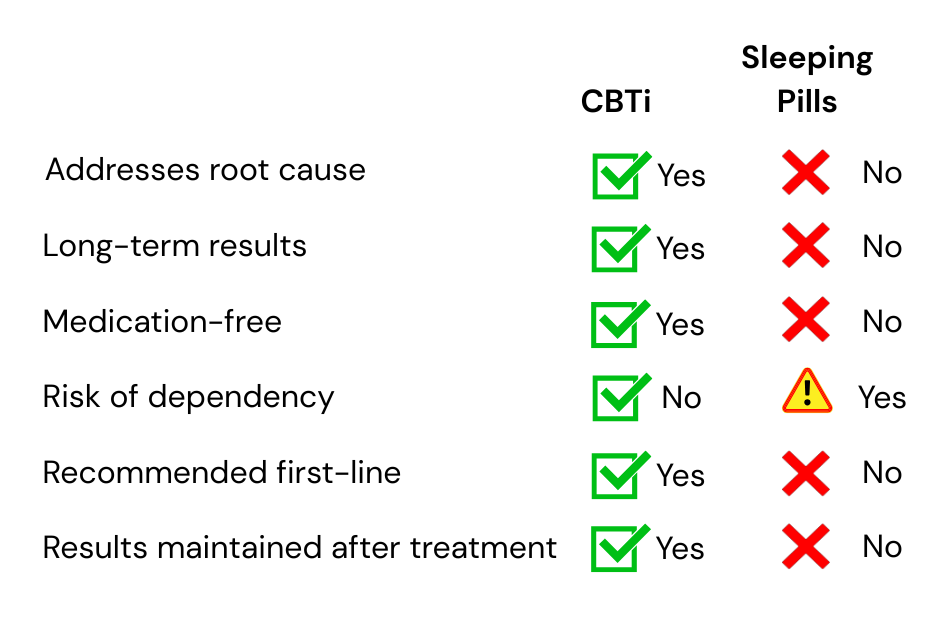
Sleeping pills have their place in short-term, acute situations. But for chronic insomnia — insomnia lasting more than three months — CBTi is the evidence-based, long-term solution.
What Does a CBTi Program Look Like at SynapReset?
At SynapReset Insomnia Therapy in Brisbane, our CBTi program is personalised to your specific sleep patterns, lifestyle, and goals. Here’s what to expect:
Step 1 — Comprehensive Assessment We take a detailed history of your sleep patterns, health, lifestyle, and goals to understand exactly what is keeping you awake and what you want to achieve.
Step 2 — Personalised Sleep Plan We analyse your sleep data and develop a structured, personalised plan to restore your natural sleep pattern using evidence-based CBTi techniques.
Step 3 — Skills and Strategies We teach you the specific skills and techniques to fall asleep consistently, stay asleep, and build healthy long-term sleep habits.
Step 4 — Follow-Up and Support Regular follow-up appointments ensure the changes stick and you continue to achieve your sleep and health goals.
All consultations are conducted via secure Telehealth, making it convenient to access from anywhere in Brisbane or across Australia. No referral is needed to get started.
Is CBTi Right for Me?
CBTi is suitable for most adults with chronic insomnia. It is particularly effective if you:
CBTi is appropriate for people of all ages and works alongside most medical conditions and medications. If you’re unsure whether CBTi is right for your situation, our free consultation is the perfect place to start.
Start Your Journey to Better Sleep
At SynapReset Insomnia Therapy, we offer a complimentary 15-minute phone consultation to discuss your sleep concerns and determine whether our CBTi program is the right fit for you.
Based in Brisbane and available Australia-wide via Telehealth, we make it simple to get started — no referral needed, no software to download, just a single click to join your session.
📞 Call us: 0461 571 392
📧 Email: contact@synapreset.com.au
🌐 Website: www.synapreset.com.au
Andrew Heathcock is a sleep therapist and advanced practice pharmacist with 20 years of experience in healthcare. He is a certified CBTi Level 1 Practitioner and founder of SynapReset Insomnia Therapy, Brisbane.
Related Articles:
Why Can’t I Sleep Through the Night?
Sleep Medications vs CBTi — Which Works Better?
5 Signs You Have Sleep Maintenance Insomnia
How Many Hours of Sleep Do Adults Really Need?
© 2026 SynapReset Insomnia Therapy, Brisbane QLD Australia